For patients with β-thalassemia, the therapeutic promise is real: take a patient’s own hematopoietic stem cells, correct them with a functional β-globin gene, and reinfuse a product with the potential to restore normal hemoglobin production. No donor match required. No lifelong immunosuppression. The science is there.
The manufacturing, historically, has not been.
A Therapy Held Back by Process Complexity
HSC therapy occupies a demanding corner of cell manufacturing. The workflow spans multiple days and multiple critical unit operations: apheresis wash, CD34+ enrichment using nanomagnetic beads, lentiviral transduction, in vitro expansion, harvest, and final formulation. Each step must preserve cell quality. Each open manipulation introduces risk. And the cells themselves — hematopoietic stem and progenitor cells — are sensitive, finite, and irreplaceable if a batch is lost.
Traditional approaches to this workflow often rely on manual steps, multiple disconnected instruments, and open processing environments. The result is a manufacturing model that is technically complex, difficult to scale, and hard to validate consistently across batches — exactly the profile that drives up costs and limits patient access.
This is not a problem unique to β-thalassemia. It reflects the broader tension at the heart of autologous cell therapy: the biology demands precision, but the manufacturing infrastructure has often struggled to deliver it reliably.
Closing the System – and the Loop
The argument for closed automated HSC manufacturing isn’t new. What has been harder to demonstrate is how well a fully automated platform actually performs across the metrics that matter in a real production setting: recovery, purity, transduction efficiency, viability through freeze-thaw, and batch-to-batch consistency.
That’s the question CellBri’s latest application note sets out to answer.
Using the CellFAB One N, a GMP-ready, fully closed, all-in-one automated cell processing system, the study for a complete HSC manufacturing workflow across 10 independent donors was conducted, starting from fresh mobilized apheresis material and proceeding through every stage to final formulated product. The data covers the full arc: not just one or two headline metrics, but performance at each critical step.
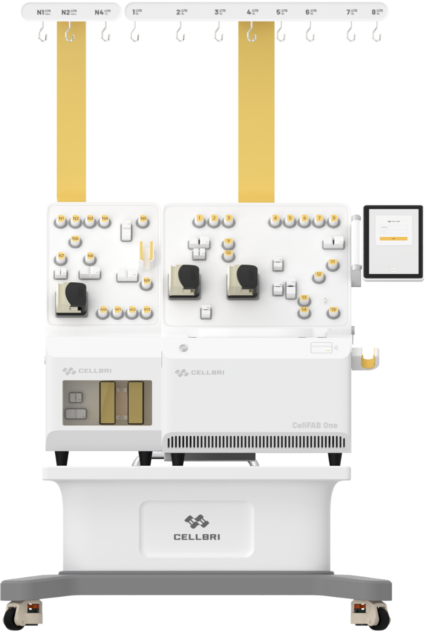
The headline numbers are strong. But what’s more telling is where the process held up, and the level of consistency observed.
What the Data Show
CD34+ HSC recovery during apheresis washing exceeded 98%, with >98% purity achieved post-enrichment. Cell viability remained above 80% through lentiviral transduction and gene modification steps, and post-thaw viability retention exceeded 95%, a metric that is directly tied to clinical product quality and cryopreservation confidence.
Importantly, these results held across all 10 donors, including variation in starting cell dose and apheresis material quality. Inter-batch consistency is one of the hardest things to demonstrate in autologous manufacturing, and it’s one of the most important.
For teams developing or scaling HSC therapy programs, the CellFAB One Series is designed to support workflows from early development through commercial production, with the flexibility to configure the system to your process, not the other way around.
The Broader Implication
Getting HSC manufacturing right matters beyond any single indication. The same closed, automated workflow architecture that supports β-thalassemia development is directly applicable to other CD34+-based programs, and the precedent set by reproducible performance data is exactly what regulatory submissions and tech transfer packages are built on.
Manufacturing is not a downstream problem to be solved after the biology is proven. It is part of what makes a therapy viable – for developers, regulators, and ultimately, for patients.
Download the Application Note.
Follow us on LinkedIn to stay connected as we continue to push the future of cell therapy manufacturing.