CAR-T therapy has earned its place as one of the most transformative advances in oncology. For patients with relapsed or refractory B-cell malignancies, it has produced responses that were previously unachievable. The clinical case is solid.
But the manufacturing case is still being built.
The Problem with Ex Vivo T Cell Production
Manufacturing autologous CAR-T cells is, by any measure, a complex undertaking. Starting from a patient’s own apheresis material, the process must isolate target T cells, activate them, introduce a viral vector for genetic modification, expand the population over multiple days, remove activation beads, harvest, and formulate – all while preserving the viability and functional integrity of cells that will ultimately be reinfused into a patient.
That’s a 10-day workflow with multiple critical unit operations, each of which can introduce variability, contamination risk, or cell stress if not carefully controlled.
Manual approaches to this process create compounding problems.
- Open manipulations increase contamination risk.
- Inconsistent handling between steps affects cell health.
- And when something goes wrong, like a pipetting error, a missed timing window, a contamination event, there isn’t a redundant batch sitting in reserve. The patient’s cells are the only cells.
This is a manufacturing model that is technically demanding, operationally intensive, and difficult to scale without sacrificing the consistency that GMP production demands.
Automation That Fits the Biology
The answer isn’t automation for its own sake. The relevant question is whether a fully closed, automated platform can execute a complete multi-step CAR-T workflow while maintaining cell quality across every stage, and in a way that translates across donors and production runs.
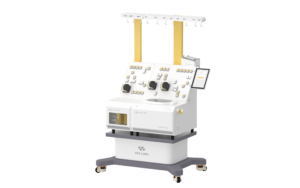
CellBri’s latest application note captures these efforts using the CellFAB One MN, an all-in-one, GMP-ready, fully closed automated cell processing system.
This study ran a complete CD19-targeted CAR-T manufacturing workflow starting from fresh apheresis material, across five independent donors. The workflow covered every step: apheresis washing, CD4/CD8 nanomagnetic bead sorting, microbead-based activation, lentiviral transduction targeting CD19, in vitro expansion, magnetic bead removal, harvesting, and final formulation and filling.
What the Data Covers
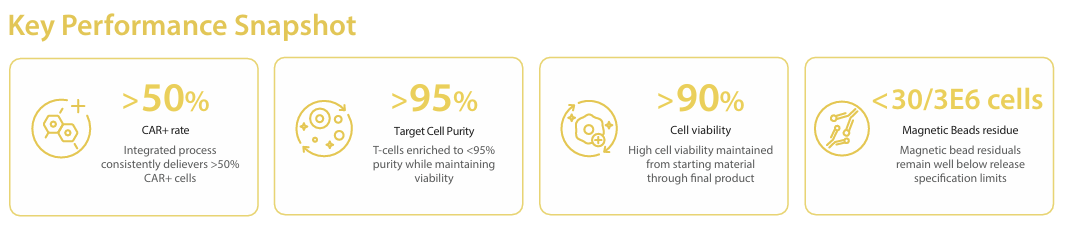
Performance data is captured across the full manufacturing arc, including T cell sort purity, B cell residue post-sorting, cell viability at each stage, CAR-positive transduction efficiency, fold expansion, final cell number, and residual magnetic bead levels in the final product.
A few highlights: CD4+/CD8+ T cell sort purity consistently exceeded 95%, while B cell residue remained below 0.2%, achieved with no observable impact on cell viability through the sorting step. Cell viability remained stable with no significant fluctuation across the entire manufacturing timeline, from starting apheresis through formulation. The final formulated product-maintained viability above 90%, and the complete process was conducted by a single operator using one set of single-use consumables in a Grade C cleanroom environment.
For teams thinking about scalability, the system supports production runs capable of generating at least 5×10⁹ cells in a single run, a meaningful threshold for autologous programs moving toward commercial volumes.
Built for the Whole Workflow
One thing worth noting: the CellFAB One MN is configured specifically to support the full CAR-T workflow, including the ex vivo expansion steps that require longer incubation periods. It’s one configuration within the broader CellFAB One Series, which is designed to be tailored to different therapy types, batch sizes, and process requirements, whether supporting autologous or allogeneic programs, early-stage development, or commercial-scale production.
The Broader Point
The CAR-T field has proven the viability of these therapies. The debate now is about whether the industry can manufacture treatments reliably, more affordably, and at a scale that makes them accessible to all patients who need it.
That requires manufacturing platforms that can take a complex, multi-day workflow and deliver consistent, high-quality output across runs and donors, without demanding an army of operators or an arsenal of instruments.
Download the Application Note
Follow us on LinkedIn to stay connected as we continue to push the future of cell therapy manufacturing.