A signed agreement is one thing. A replicable model for getting cell therapies to patients across borders is another. The Memorandum of Understanding (MOU) signed on June 9th between CellBri, Fosun Kairos, and Spain’s Hanser Medical Biotech S.L. is being built with the second goal in mind.
The three parties are joining forces to explore what it would take to bring Fosun Kairos’s proprietary CAR-T products into the European market, with Spain as the priority entry point. But the ambition behind the partnership goes further than a single market or a single therapy. It’s about building something that is repeatable.
Why This Combination Makes Sense
Bringing a cell therapy from one country’s commercial infrastructure to another isn’t a licensing exercise. It requires deep alignment across clinical, regulatory, manufacturing, and commercial functions, simultaneously, in a new market context.
 Photo caption (left to right): Hanser Medical Biotech S.L. General Manager, Sergi Ramirez; CellBri Founder and CEO, Dr. Shang Yuanfang; Fosun Kairos CEO, Chen Xingrong
Each party in this collaboration brings a distinct and necessary capability.
Fosun Kairos contributes the clinical foundation: commercially approved CAR-T products with real-world manufacturing and patient treatment experience behind them. That’s not a starting point many developers reach. The company has navigated the full arc from clinical development through commercial launch in China, a market with its own complexity and scale, and that track record matters when entering a new regulatory environment.
Hanser Medical Biotech brings the European infrastructure layer: commercial networks, hospital channel relationships, and on-the-ground expertise in Spain’s advanced therapy regulatory and clinical environment. During the June 9th visit to Fosun Kairos’s Pingshan facility, Hanser experts shared detailed perspectives on Spain’s hospital-based GMP platform development, clinical translation frameworks, and the regulatory pathways relevant to ATMPs in the European context. That local fluency is not something that can be quickly acquired from the outside.
CellBri’s role sits at the manufacturing layer. As the CGT field has expanded globally, one of the most persistent friction points in cross-border deployment has been manufacturing: specifically, the ability to reproduce a validated process reliably in a new setting, with different personnel, facilities, and supply chains.
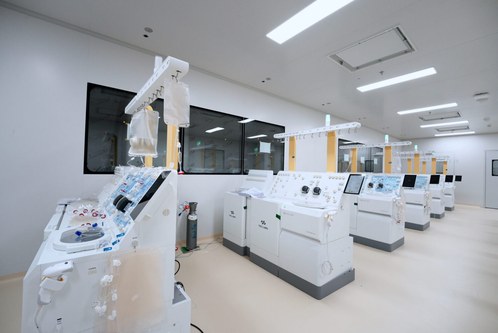
CellBri’s automation platforms are designed around exactly this challenge: closed-system, configurable, and built to translate processes across sites and scale without sacrificing consistency or compliance.
The System Has to Work Together
One of the clearest lessons from the broader CGT field is that no single capability is enough on its own. A therapy with strong clinical data but no scalable manufacturing path stalls. A manufacturing platform without regulatory alignment can’t get product to patients. A commercial network without the right clinical and quality infrastructure behind it can’t sustain what it sells.
As we’ve explored previously, the access problem in cell therapy is fundamentally a systems problem. The science has proven it can work. What the industry is still building is the coordinated infrastructure that translates a therapy that “works” to a therapy that “patients can reliably receive.”
That’s the model this three-party collaboration is designed to test: regulatory registration, clinical cooperation, localized manufacturing, and commercial expansion – advancing together, not sequentially.
Spain as a Starting Point, Not an Endpoint
The choice of Spain as the initial focus is deliberate. The country has a well-developed advanced therapy regulatory framework, hospital-based GMP capabilities, and a clinical research infrastructure that can support early European deployment. Experts from the Carlos III Health Institute and the Cantabria Health Research Institute, both present at the June 9th visit, bring direct insight into how that system operates and where the opportunities for collaboration sit.
But the three parties are clear that Spain is a starting point. The explicit aim is to develop a cross-border collaboration model that is replicable; one that, if it works in Spain, can inform how Chinese CGT innovations are brought to additional markets over time.
What Comes Next
The MOU establishes the framework. Specific technical and commercial agreements will follow as the collaboration takes shape. In the near term, the focus will be on mapping the regulatory pathway for Fosun Kairos’s CAR-T products within Europe’s ATMP framework, identifying clinical collaboration opportunities, and defining the manufacturing model that could support localized production.
CellBri’s involvement reflects a broader conviction: that the infrastructure enabling CGT to cross borders (reproducible manufacturing, quality systems, and process standardization) is as important to the field’s global impact as the therapies themselves. Getting that layer right, early, is what makes scale possible.
The work is just beginning. But the structure to do it seriously is now in place.
Follow us on LinkedIn to stay connected as we continue to build the future of cell therapy manufacturing.