The Real Bottleneck Isn’t Science
The CGT field has spent two decades proving that the biology works. What it hasn’t fully solved is how to move from a successful clinical result to a repeatable, scalable, compliant manufacturing process; one that can survive technology transfer, cross borders, and be executed consistently across sites and systems.
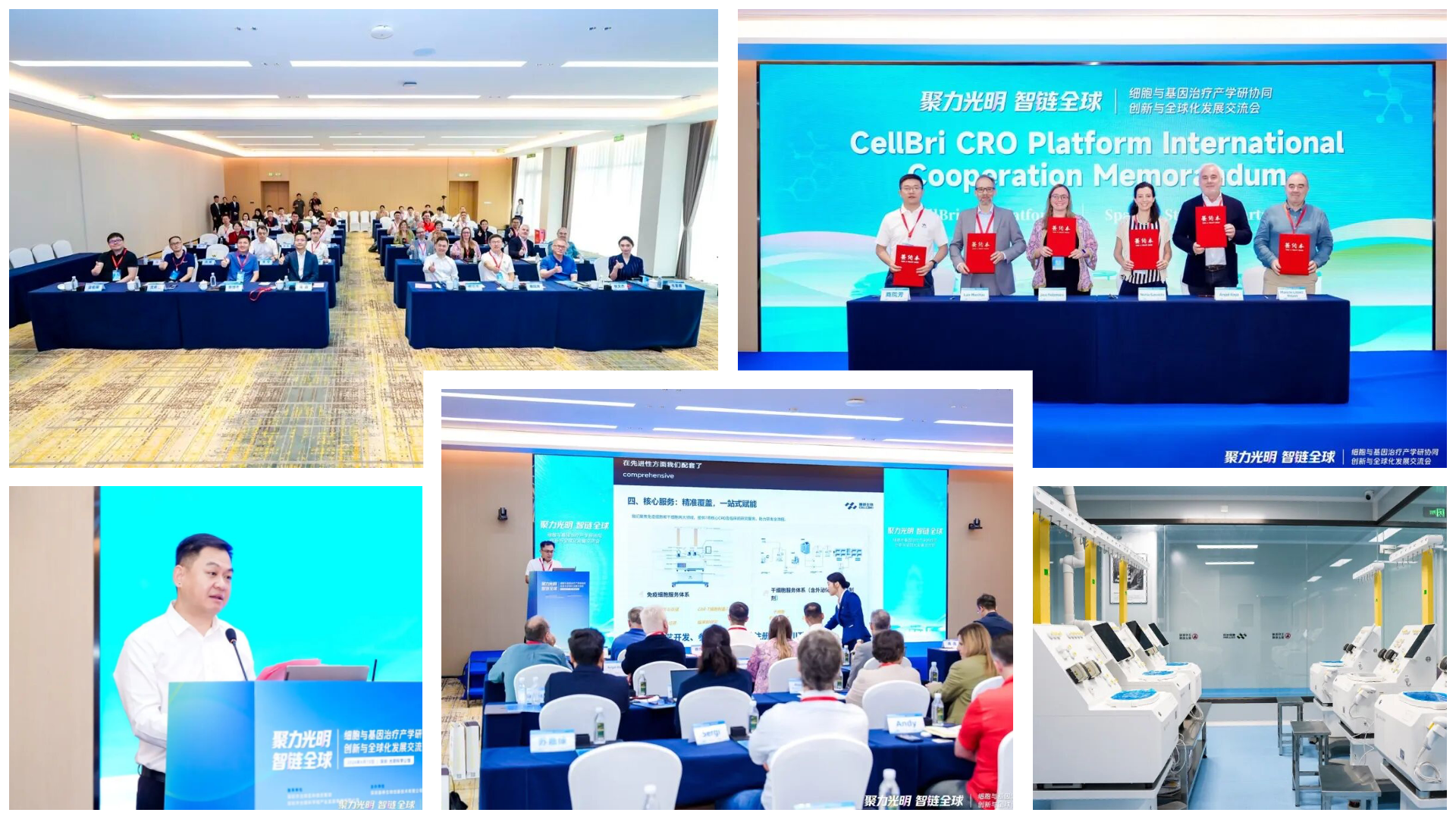
CellBri’s Founder and CEO, Dr. Shang Yuanfang, explained that if CGT is to go global, it can’t be done by a single company, a single pipeline, or a single product acting alone. He expanded on that statement, saying that the core challenge isn’t technology – it’s the infrastructure: manufacturing processes, quality systems, equipment and consumables, regulatory submissions, clinical networks, and supply chains.
These are not new observations. But it’s become increasingly urgent. China’s CGT sector is maturing rapidly, with hundreds of clinical trials registered over the past decade and a domestic ecosystem that is localizing key inputs, from viral vectors to automated cell preparation platforms, in ways that are beginning to meaningfully compress costs. As captured in an earlier CellBrief post, that cost-reduction progress is real, and it matters enormously for global access. But cost is only one dimension of the translation challenge.
The deeper issue is that even therapies with strong clinical data can stall between the lab and the clinic; not because the science fails, but because the manufacturing and quality infrastructure isn’t ready to carry them forward.
A New Translation Engine for CGT
The most significant announcement at the Guangming forum was the official launch of the CGT Common Public Service Platform, a shared CRO facility co-developed by CellBri and Guangming Science and Technology Development Group, purposefully built to close the translation gap.
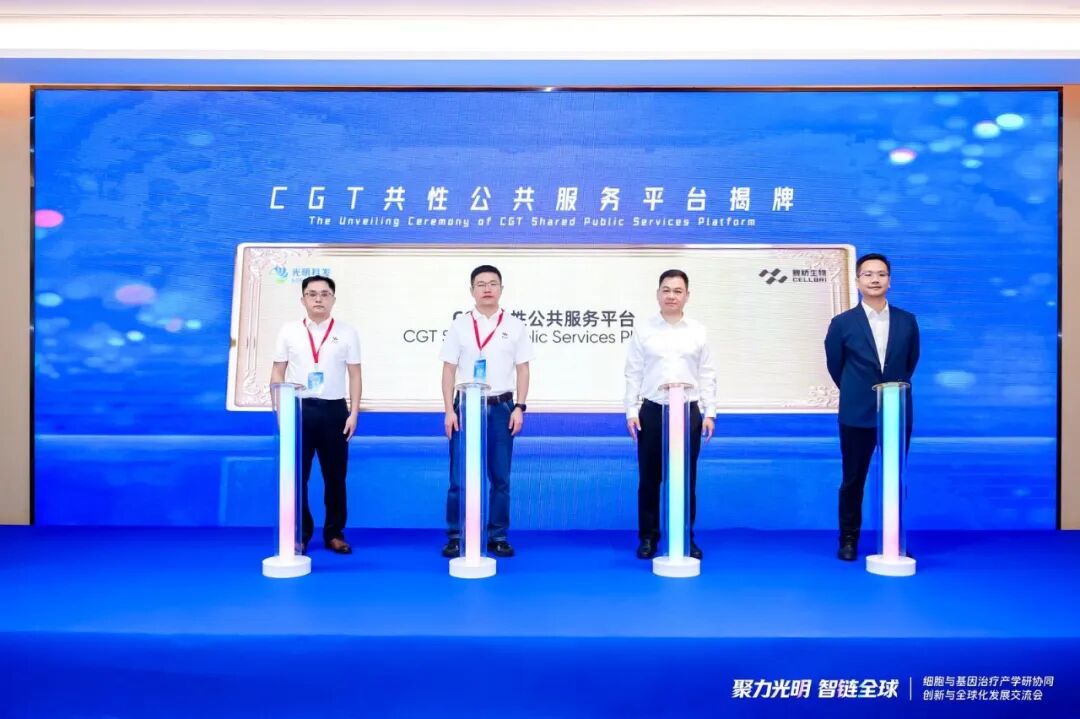 Photo caption (left to right): Head of the CGT Common Public Service Platform, Liang Zhirong; CellBri Founder and CEO, Shangyuan Fang; Guangming District Science and Technology Innovation Bureau Director, Chen Xiaoqing; Guangming Science and Technology Development Group Lead, Fu Xin.
The platform’s mandate is specific and practical: provide the infrastructure that early-stage CGT developers need to move from promising data to IND-ready processes without having to build everything themselves. That means process development and optimization, CMC research, analytical method development and validation, quality system support, and clinical submission preparation, all under one roof, in a GMP-compatible environment.
Phase one of the construction covers approximately 1,200 square meters, equipped with fully automated closed-system cell preparation systems and ISO Class 7 (Grade B/C) cleanrooms with localized ISO Class 5 (Grade A) operations. The facility is designed to support everything from pilot-scale development and multi-batch runs to individualized patient-specific preparations; the kind of flexibility that early-stage programs need before they know exactly what scale they’re heading toward.
The underlying logic is compelling: if you can standardize and de-risk the manufacturing process at the research and early clinical stage, rather than retrofitting it at commercial scale, the path forward becomes faster, cheaper, and less likely to hit regulatory walls. It’s the same principle we’ve described in the context of CellBri’s automation philosophy: quality built in early is significantly less expensive than quality corrected later, while challenging the traditional “Race to Phase 1” mentality.
Building for a Global Ecosystem
The platform launch was accompanied by a set of strategic partnership signings that signal the ambitions at play. Clinical collaboration agreements were signed with Fosun Kairos and Sun Yat-sen University’s Seventh Affiliated Hospital, anchoring the platform’s domestic clinical network. And multiple agreements were executed with Spanish research and industry partners, formalizing a China-Europe CGT collaboration focused on clinical translation, platform development, and regulatory pathway alignment.
That international dimension matters. Europe’s hospital exemption framework and evolving ATMP regulatory environment represent a meaningful alternative pathway for CGT developers looking beyond the FDA track. The forum’s European expert sessions, covering clinical translation models, cell therapy alliance structures, and cross-border partnership mechanisms, reflected the recognition that global CGT expansion requires genuine regulatory and operational fluency in multiple markets, not just a domestic playbook extended overseas.
CellBri’s vision for this is direct: a model of domestic standardization deployed first, then rapidly replicated internationally, with the platform serving as the anchor for a broader global CGT infrastructure and cooperation network.
What This Signals for the Industry
Guangming District’s ambitions are not modest. The local government is positioning the district as the Greater Bay Area’s CGT hub, leveraging its science city infrastructure, research universities, clinical translation platforms, industry funds, and a growing cluster of equipment and materials suppliers, to build a full industry chain from upstream inputs through to clinical application. The CGT Common Public Service Platform is a material step toward that goal.
But the broader signal extends beyond any single district or company. The convergence of China’s manufacturing cost curve, more flexible regulatory frameworks (including the FDA’s updated CGT guidance earlier this year), and a new generation of automation platforms designed for adaptability and openness is creating the conditions for a genuine step-change in how CGT gets built, scaled, and deployed globally.
The science has delivered its proof of concept. What comes next is the harder, less visible, and arguably more important work: building the systems that turn breakthrough therapies into products that can reach patients reliably, repeatedly, and at a price that makes access possible.
That work is underway. And it’s accelerating.
Follow us on LinkedIn to stay connected as we continue to build the future of cell therapy manufacturing.